
CEN SAND (BSEN 196-1)
Product Details:
- Color Light Yellow
- Application Laboratory testing, Cement testing
- Installation Type Ready to Use
- Features Consistent Particle Size Distribution
- Material Grade BSEN 196-1 Standard
- Usage Physical and chemical testing
- Machines Type Testing Machines
CEN SAND (BSEN 196-1) Price And Quantity
- 100 Twenty-Foot Container
- Sigma Test & Research Centre
- European Norms EN 196-1
- Keep away from moisture
- Rounded
- Approx. 1.45 g/cm³
- Plastic/Laminated Bags
- <0.2%
- According to EN 196-1
CEN SAND (BSEN 196-1) Product Specifications
- Dry sand
- 0.50 mm to 2.00 mm
- 99% Quartz
- Natural Quartz
- Washed and Graded
- 25 Kg Bag
- High purity, uniform grain size
- Testing Machines
- Physical and chemical testing
- BSEN 196-1 Standard
- Granular
- Laboratory testing, Cement testing
- 0.50 mm to 2.00 mm
- CEN Standard Sand
- Consistent Particle Size Distribution
- Ready to Use
- Light Yellow
- Sigma Test & Research Centre
- European Norms EN 196-1
- Keep away from moisture
- Rounded
- Approx. 1.45 g/cm³
- Plastic/Laminated Bags
- <0.2%
- According to EN 196-1
CEN SAND (BSEN 196-1) Trade Information
- Cash on Delivery (COD)
- 00 Week
- All India
Product Description
Cen Sand (Bsen 196-1)
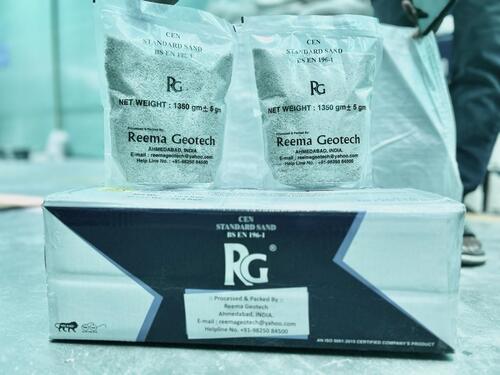
CEN Standard sand (ISO standard sand) is a natural sand, which is siliceous sand consisting preferably of rounded particles and has a silica content of atleast 98% , particularly its finest fractions .It is dried, screened and prepared in a modern workshop which offers every guarantee in terms of quality and consistency.
The sand is packaged in polyethylene bags (Standing Pouch) each containing 1.350 grams.
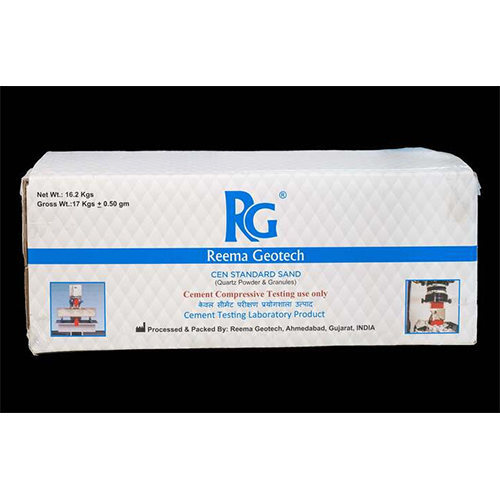
Deliveries are made in boxes of 10 bags weighing 13.5 kg and suitably protected by a polyethylene cover.
Particle Size Distribution
The grading, measured by sieving, complies with the requirements of EN 196-1:2005 and ISO 679 : 2009 ( E ) .
|
Square mesh Size (mm) |
Cumulative sieve residue(%) |
|---|---|
| 2.00 | 0 |
| 1.60 | 7 + 5 |
| 1.00 | 33 + 5 |
| 0.50 | 67 + 5 |
| 0.16 | 87 + 5 |
| 0.08 | 99 + 1 |
This analysis is complemented by bag mass controls, water content controls and strength controls, in accordance with EN 196-1:2005 and ISO 679 : 2009 ( E ).
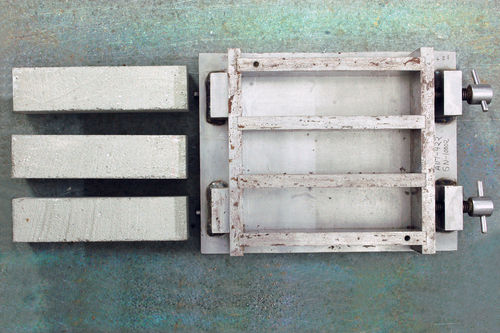
| control the strength of cement : Standard sand is used to control the strength of cement and other hydraulic binders : The methods of testing cement strength requires the use of standard sand and reference sand. They are used to measure resistance to compression of test pieces of mortar. |
European Norms Compliance
CEN SAND (BSEN 196-1) strictly adheres to EN 196-1 standards, ensuring consistent quality and reliable results for laboratory cement testing. The manufactured sands grain size and shape are engineered to meet these stringent requirements, making it the standard for concrete and mortars used in research and development settings.
Optimal Storage and Packaging
The sand is packaged in secure plastic or laminated bags to prevent moisture ingress and contamination during transportation or storage. For best results, it should be kept in a dry, indoor environment, away from any sources of moisture, to preserve its low moisture content and maintain the integrity of the sample.
FAQs of CEN SAND (BSEN 196-1):
Q: How should CEN SAND (BSEN 196-1) be stored to maintain its properties?
A: CEN SAND should be stored in a dry place, away from moisture, and kept in its original sealed plastic or laminated bags to maintain its low moisture content and prevent contamination.Q: What is the main benefit of using CEN SAND (BSEN 196-1) in laboratory testing?
A: The main benefit lies in its strict adherence to EN 196-1 standards and controlled particle size distribution, which ensures reliable, repeatable results during cement testing procedures.Q: When is CEN SAND (BSEN 196-1) typically used in the industry?
A: This sand is most commonly used during laboratory processes for the testing and evaluation of cement properties, especially in accordance with European and international standards.Q: Where does Sigma Test & Research Centre supply CEN SAND (BSEN 196-1)?
A: Sigma Test & Research Centre supplies and exports the sand from India to various domestic and international clients, supporting both manufacturers and research laboratories.Q: What process is followed to manufacture CEN SAND (BSEN 196-1)?
A: The sand is manufactured with a controlled process to produce rounded grains and achieve a precise particle size distribution that conforms to EN 196-1 norms, ensuring quality and uniformity.Q: How can CEN SAND (BSEN 196-1) be utilized effectively in cement testing?
A: Use the sand directly from the sealed packaging in prescribed proportions, as per EN 196-1, to prepare test mixes. This provides accurate assessment of cement performance characteristics.
Price:
- 50
- 100
- 200
- 250
- 500
- 1000+

Other Products in 'CEN SAND (BSEN 196-1)' category

Quality Is Not a Matter Of Chance Testing Ensures Quality

- Survey No: 101, Part B, T.P. 217, Opp. Jay & Rahul Farm, K.K Patel Farm Road, Shilaj,Ahmedabad - 380059, Gujarat, India
- Phone : 07971191341

- Send Inquiry
- Mr. Pinal Patel
09825084500
 Send Inquiry
 Send Inquiry
 Send SMS
 Call Me Free
Developed and Managed by Infocom Network Private Limited.

