
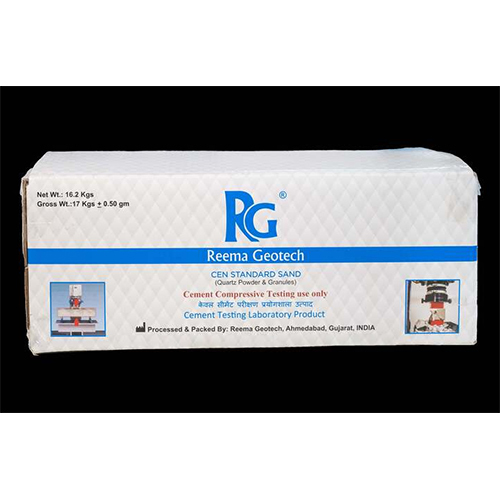
CEN STANDRAD SAND (EN 196-1)
Product Details:
- Color Light Beige to Whitish
- Application Testing cement, mortar, and other construction materials
- Form Dry, Granular
- Machines Type Material Testing Machines (Mortar Mixer, Cube Moulds, etc.)
- Installation Type Direct use in laboratory testing
- Usage Physical, mechanical property testing of cement and binders
- Purity >98% SiO2
CEN STANDRAD SAND (EN 196-1) Price And Quantity
- 1 Unit
CEN STANDRAD SAND (EN 196-1) Product Specifications
- Dry, Granular
- Light Beige to Whitish
- Testing cement, mortar, and other construction materials
- Quartz Silica Sand
- Consistent particle size, High purity, Low moisture content
- Physical, mechanical property testing of cement and binders
- Washed and Graded
- Granular
- Direct use in laboratory testing
- Material Testing Machines (Mortar Mixer, Cube Moulds, etc.)
- Normed Grain Size 0.082 mm
- Standardized, Bagged, Ready to use
- 1350 5 g per bag (for reference)
- Standard Sand
- >98% SiO2
CEN STANDRAD SAND (EN 196-1) Trade Information
- Cash in Advance (CID)
- 1 Unit Per Week
- 1 Week
- Yes
- Asia
- All India
Product Description
Cen Standrad Sand (En 196-1)
CEN Standard sand (ISO standard sand) is a natural sand, which is siliceous sand consisting preferably of rounded particles and has a silica content of at least 98%,particularly its finest fractions.It is dried, screened and prepared in a modern workshop which offers every guarantee in terms of quality and consistency.
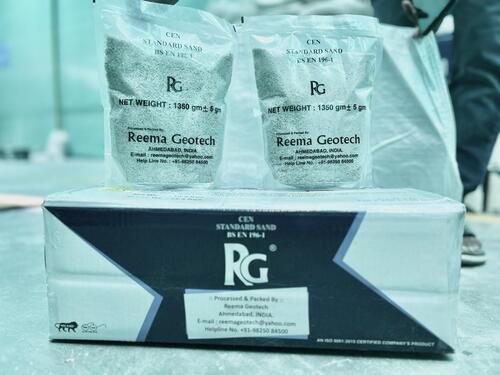
The sand is packaged in polyethylene bags( Standing Pouche )each containing 1 350 +5 g.
Deliveries are made in boxes of10 bags weighing 13.5kg and suitably protected by a polyethylene cover.
Particle Size Distribution
The grading, measured by sieving, complies with the requirements of EN 196-1:1994 and ISO 679: 2009 ( E ).
|
Square mesh Size (mm) |
Cumulative sieve residue(%) |
|---|---|
| 2.00 | 0 |
| 1.60 | 7 + 5 |
| 1.00 | 33 + 5 |
| 0.50 | 67 + 5 |
| 0.16 | 87 + 5 |
| 0.08 | 99 + 1 |
This analysis is complemented by bag mass controls, water content controls and strength controls, in accordance with EN 196-1:1994 and ISO 679: 2009 ( E ).
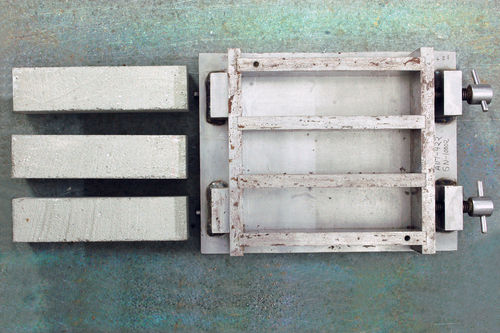
| Control the strength of cement Standard sand is used to control the strength of cement and other hydraulic binders: The methods of testing cement strength requires the use ofstandard sandand reference sand. They are used to measure resistance to compression oftest pieces of mortar. |
Consistent Laboratory Performance
CEN Standard Sand guarantees uniform particle size and high chemical purity, vital for achieving repeatable results in cement and mortar testing. Its predictable performance enables laboratories to compare results across tests and facilities, fulfilling stringent international standards and protocols.
Ready-to-Use Convenience
This product is bagged, dry, and available in a perfectly measured weight, removing the need for preparatory procedures. Laboratories can use it directly in material testing machines, accelerating workflow and minimizing contamination risk. Each batch meets EN 196-1 requirements, ensuring you save time and maintain compliance.
FAQs of CEN STANDRAD SAND (EN 196-1):
Q: How should CEN Standard Sand (EN 196-1) be used in laboratory testing?
A: CEN Standard Sand is intended for direct use in laboratory tests involving cement, mortar, and binders. Simply add the pre-measured, dry sand to material testing machines like mortar mixers or cube moulds as required by test protocols.Q: What are the main benefits of using this quartz silica sand for cement testing?
A: This sand offers superior consistency in grain size, high purity (>98% SiO2), and minimal moisture content, which all contribute to more accurate, reproducible results. Its ready-to-use, standardized formulation helps laboratories reliably demonstrate product quality and complies with EN 196-1 standards.Q: When is it appropriate to use CEN Standard Sand (EN 196-1) for material testing?
A: It should be used whenever conducting physical or mechanical testing of cement, binders, or mortar, especially where standardized conditions are required for comparison, certification, or research purposes according to EN 196-1.Q: Where can this standard sand be applied besides cement and mortar testing?
A: While primarily designed for cement and mortar test methods, it can also be employed for other construction materials research and quality assurance processes demanding consistent granular test media.Q: What is the process for preparing the sand before use in tests?
A: No preparation is necessary; the sand arrives washed, graded, dry, and pre-measured. It is ready for immediate use in testing, expediting laboratory workflows.Q: Why is consistent particle size important in material testing?
A: Uniform particle size ensures repeatability and precision in laboratory measurements, minimizes variation among tests, and directly impacts the reliability of results across different batches and laboratories.
Price:
- 50
- 100
- 200
- 250
- 500
- 1000+

Other Products in 'CEN SAND (BSEN 196-1)' category

Quality Is Not a Matter Of Chance Testing Ensures Quality

- Survey No: 101, Part B, T.P. 217, Opp. Jay & Rahul Farm, K.K Patel Farm Road, Shilaj,Ahmedabad - 380059, Gujarat, India
- Phone : 07971191341

- Send Inquiry
- Mr. Pinal Patel
919825084500
 Send Inquiry
 Send Inquiry
 Send SMS
 Call Me Free
Developed and Managed by Infocom Network Private Limited.

